Start with the Function Beneath the Aggregate
An order for “8 oz fabric” can still deliver the wrong geotextile. Mass describes how much material occupies a unit area; it does not establish the opening size, installation survivability, or protection performance needed at a particular interface.
For 4 oz vs 8 oz geotextile fabric, establish the function first. A drainage filter must admit water while retaining the adjacent soil. A separation layer must withstand placement and keep soil from contaminating aggregate. A cushion beneath a geomembrane must limit contact damage under the actual overlying material. These are different selection problems.
Ask where the fabric sits, what touches each face, and what happens during construction. Angular aggregate dropped onto a soft foundation creates a different demand from rounded drainage stone placed carefully in a trench. Doubling the nominal fabric mass does not resolve an unsuitable pore structure or an uncontrolled placement method.
Our geotextile range provides the product starting point. The purchasing decision should then follow the project specification, supported by a grade-specific technical submission.
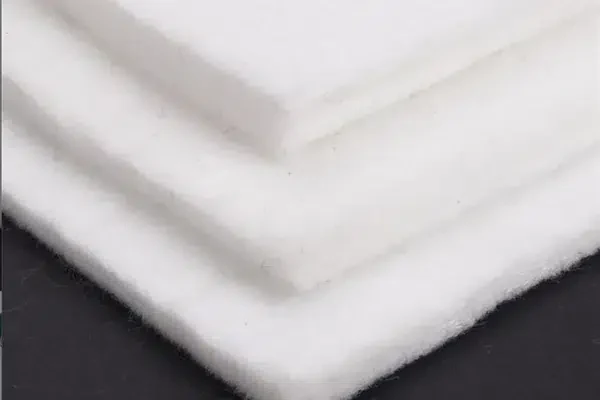
Convert the Weight Label, Then Compare the Performance Table
In this context, oz means ounces per square yard. Using standard unit conversion, 1 oz/yd² is approximately 33.906 g/m². Therefore, 4 oz/yd² is approximately 135.6 g/m² and 8 oz/yd² approximately 271.2 g/m². These are conversions, not confirmation that a particular metric grade meets either commercial designation.
ASTM D5261 addresses mass per unit area. Strength and hydraulic properties require their own methods and acceptance limits. [2]
The published filament-polyester data sheet illustrates why the full table matters. BTF150 lists 150 g/m², 11 kN/m machine-direction tensile strength, and 10 kN/m transverse tensile strength. BTF300 lists 300 g/m², 19 kN/m and 17 kN/m respectively. Those are separate grade values; neither grade should be relabelled as an exact 4 oz or 8 oz product without the agreed tolerances. [1]
| Comparison item | What the weight label tells you | What the submission must add |
|---|---|---|
| Mass | Nominal material quantity | Test method and allowable variation |
| Tensile performance | No direct acceptance value | Direction, method, strength and elongation |
| Filtration | No soil compatibility result | Opening-size designation and hydraulic evidence |
| Protection | No liner damage assessment | Puncture data and relevant system evaluation |
Wide-width tensile testing under ASTM D4595 and static puncture testing under ASTM D6241 answer different questions. A stronger result in one test does not automatically compensate for a deficient result in another. [3][4]
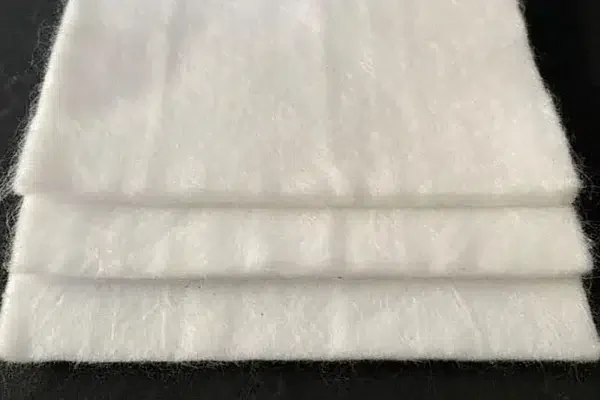
Check the Placement Method Before Approving the Fabric
Review the subgrade before opening rolls. Remove protruding debris and identify soft spots, standing water, sharp transitions, and features that could stretch the sheet when fill is placed. The geotextile should follow the prepared surface without being pulled across unsupported depressions.
Confirm overlap or seam details against the approved drawings and installation instructions. There is no useful universal overlap for every soil, loading condition, and material. Mark the required arrangement on the installation plan, including curves, trench corners, and changes in roll direction.
The first aggregate placement is a practical inspection point. Observe whether the fabric moves, wrinkles, tears, or allows aggregate to punch into the soil. Equipment movement and fill placement must follow the approved construction method; a heavier fabric is not permission to drive directly on an exposed layer.
A useful QC check is to compare the roll label, delivery certificate, and approved grade before the roll is covered. Once the aggregate is in place, discovering that a lighter or differently constructed fabric was supplied becomes a removal problem rather than a paperwork correction.
Document damage and repair it using the accepted project detail. Do not hide an unreviewed tear beneath additional aggregate or assume an overlap placed in the wrong direction will remain closed during spreading.
Check a Proposed Weight Substitution
Consider a quotation that offers a nearby metric grade in place of the specified ounce designation. Put the original requirement and proposed grade side by side, including mass tolerance, hydraulic properties, strength methods and roll dimensions. Ask which lines are directly supported by the offered documents and which still need confirmation.
Do not accept “heavier” as the entire technical justification. A replacement may have more mass but a different construction or opening-size basis. Equally, do not reject a well-supported alternative solely because its commercial label differs. The approval record should identify the accepted product and the actual properties used for the decision.
Keep that comparison with the purchase order and delivery inspection. Otherwise, an agreed alternative can become difficult to identify when the site receives rolls bearing a different grade name. The useful record is the approved specification-to-product comparison, not an email containing only a weight label.
Compare Installed Cost and Relevant Durability
A heavier grade generally uses more material, but its purchase price is only one component of installed cost. Wider rolls, fewer awkward joins, better handling arrangements, and lower rejected quantities can affect the commercial comparison.
Prepare a delivered-area calculation that includes overlaps, cuts, damaged material, and site access. For an illustrative 1,000 m² layout with a separately assumed 8% allowance, the preliminary procurement area is 1,080 m². The allowance must come from the actual roll layout; 8% is an example, not an installation standard.
Durability also depends on polymer, exposure, chemical conditions, and the material’s role. A short-term UV retention result should not be translated into a fixed exposed service life. Record storage and exposure requirements separately from buried performance requirements.
Avoid paying for extra mass where it adds no demonstrated benefit, but do not reduce a specified grade merely because a thinner product looks similar. A legitimate alternative is supported by comparable test results and an accepted technical review.
For containment projects, review the adjacent geomembrane as part of the interface. The fabric and liner need to work together under the project’s loading and contact conditions.
Specify the Grade and the Acceptance Evidence
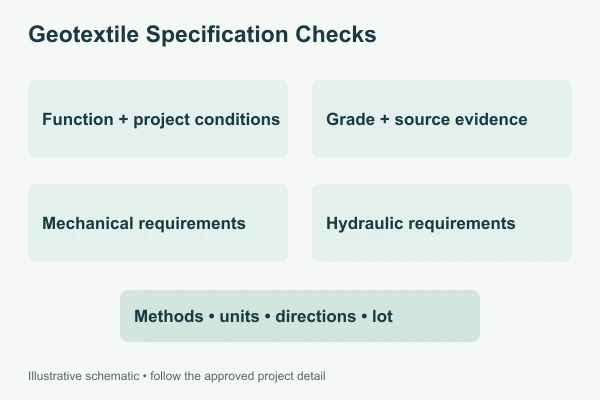
A workable purchase description identifies the construction type and polymer, required properties, test methods, roll dimensions, tolerances, and documentation. “4 oz nonwoven” or “8 oz heavy duty” alone leaves too much interpretation to the supplier.
Before requesting a quotation, assemble this checklist:
- Identify separation, filtration, protection, or another primary function.
- Provide the relevant soil, aggregate and layer arrangement.
- State the required mass with its unit and permitted variation.
- Specify strength, puncture and hydraulic acceptance criteria separately.
- Confirm machine and transverse directions where applicable.
- Include installation, joining and repair requirements.
- Request grade identification and lot-specific conformity documents.
- Compare delivered usable area and handling conditions.
When a proposed alternative uses a nearby metric mass, ask for a written comparison rather than accepting a verbal equivalence. Differences in manufacturing structure can matter more than a small difference in nominal weight.
Send the specification and quantity layout through our project inquiry page so the proposed grade and available documentation can be reviewed together.
References
Tech Note: Convert oz/yd² to g/m² on the comparison sheet, but approve the product against its verified performance requirements, not the converted mass alone.