Start with the Expanded Panel, Not the Shipping Bundle
A geocell fill calculator can produce a precise-looking number from incomplete inputs. The basic calculation is simple, but the quantity becomes unreliable if the panel is not expanded to the intended geometry or if loose and compacted fill are mixed in one total.
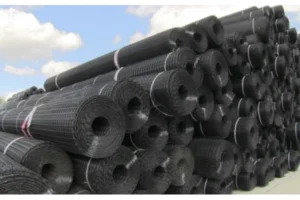
Begin with the accepted section and the actual geocell configuration. Confirm expanded area, cell height, treatment of boundaries and any specified cover above the cells. A collapsed bundle dimension does not describe the installed surface area.
The calculation estimates quantity; it does not select the structural section. The designer determines the required system and performance basis using the relevant site conditions and loading.
Keep the calculation worksheet explicit enough for the installer and supplier to reproduce. Label every input as a drawing requirement, confirmed product dimension, measured site quantity or estimating assumption.
Separate Geometric Volume from Order Quantity
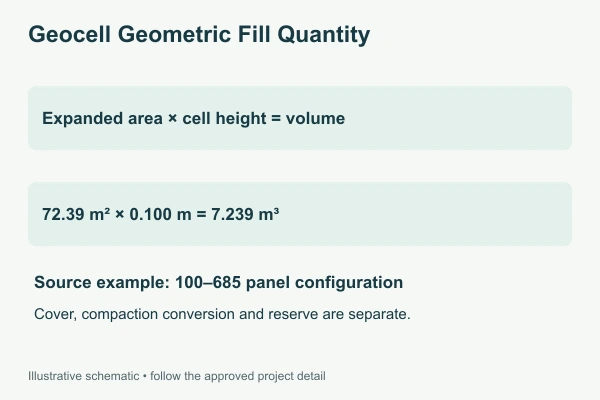
For a uniform expanded area, the simple geometric infill volume is area multiplied by cell height. Use compatible units and state the result as a compacted geometric volume where that is the intended basis.
The source sheet’s 100-685 textured-and-perforated example lists a 100 mm wall height, expanded dimensions of 5.08 m × 14.25 m and an area of 72.39 m². The corresponding geometric volume to the cell tops is 72.39×0.100 = 7.239 m³. This calculation does not include any additional cover, irregularities or loose-volume allowance. [1]
| Quantity component | Example input | Example result |
|---|---|---|
| Expanded panel area | 5.08 m × 14.25 m | 72.39 m² |
| Cell-top geometric fill | 72.39 m² × 0.100 m | 7.239 m³ |
| Hypothetical additional cover | 72.39 m² × 0.025 m | 1.80975 m³ |
| Combined geometric quantity | Example cell fill plus example cover | 9.04875 m³ |
The 25 mm cover is an illustrative assumption, not an installation recommendation. Use the cover required by the approved section and method. Do not count it again if a measured total depth already includes the cells and cover.
If an illustrative loose-to-compacted factor of 1.15 is separately assumed, 9.04875 m³ becomes approximately 10.41 m³ loose. The factor must be established for the actual material and procurement basis; it is not a universal allowance.
ASTM D8269 provides geocell-use guidance. It does not make one panel example or a calculator output suitable for every roadway or ground condition. [2]
Verify the Geometry During Installation
Check the expanded dimensions and cell arrangement before fixing the panels. Under-expansion and over-expansion can change the installed area and local geometry, making the quantity worksheet inconsistent with the work on site.
Inspect panel connections, boundaries and the supporting surface. A quantity based on a flat uniform rectangle does not automatically include local depressions, transitions, slopes or returns. Measure and record those features separately where they affect fill.
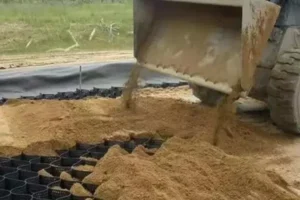
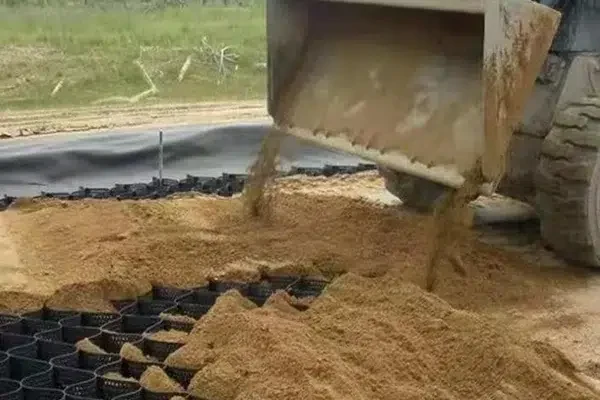
Place infill using the accepted construction sequence, maintaining the cell arrangement and equipment controls. The first filled area is useful for checking whether the planned supply rate and handling method match the actual work.
Keep compaction acceptance separate from the volume calculation. Ordering an allowance for loose fill does not establish that the placed material has reached the specified density or performance.
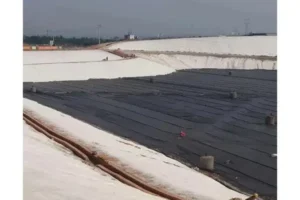
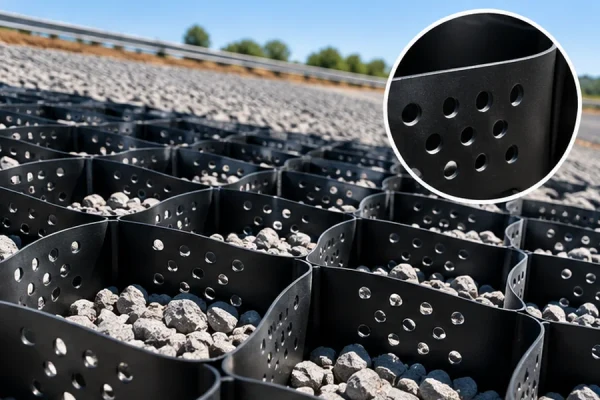
Where the section includes a separator or filter, confirm the geotextile layer before cells are filled. Geocell wall perforations do not replace an independently required soil-filter arrangement.
Record quantities by installation zone and delivery basis. Truck volume, weighed tonnage, loose stockpile volume and compacted volume are different measures and should not be reconciled without the relevant density and measurement information.
Reconcile Delivered Fill Without Mixing Quantity Bases
Consider deliveries priced by weighed tonnage while the installation estimate is in compacted cubic metres. Record the material and condition for the density conversion before comparing the totals. A loose stockpile density should not be silently treated as the compacted installed density.
Check whether delivery measurements include moisture or other allowances relevant to the commercial basis. Keep those terms in the procurement worksheet so an apparent shortage is investigated against comparable quantities.
Use the first completed zone to review the estimating assumptions where the project permits it. Measure the installed area and geometry, record delivered material on its stated basis, and identify any additional cover or local irregularity. Adjust later orders only from a documented quantity review. Do not alter the accepted section merely to make delivered and estimated totals agree. The calculation controls procurement; the design controls the required construction.
Control Commercial Allowances Without Counting Them Twice
Separate geometric fill, cover, compaction conversion, cutting or boundary loss, and operational reserve. This allows each allowance to be reviewed rather than hiding several assumptions in one percentage.
For a large order, small changes in cell height or confirmed expanded area can materially change the total volume. Recalculate when the panel configuration changes; do not keep the old quantity while substituting a different cell depth.
If fill is purchased by mass, use a justified bulk-density basis for the material and condition being ordered. Wet density, dry density and compacted density should not be substituted without explanation.
The installed cost also includes panel fixing, connections, handling, spreading, compaction and the accepted supporting layers. A lower infill quantity is not automatically an approved design saving.
For long-term service, the fill needs to suit the intended function, exposure and drainage conditions. Quantity accuracy cannot compensate for an unsuitable aggregate or a section that does not match the design requirements.
Keep a revision history for the calculation. When the drawing, cell height, fill source or supply basis changes, record which inputs were revised and whether earlier orders remain suitable.
Issue a Reproducible Fill Worksheet
Before release, ask another team member to reproduce the result from the listed inputs. This catches unit errors and hidden assumptions more effectively than checking the final number alone.
The worksheet should include:
- Approved product and expanded panel configuration.
- Net treated area and measured irregularities.
- Cell height in metres for the calculation.
- Specified additional cover, if any.
- Compacted geometric volume.
- Justified loose-volume or mass conversion basis.
- Separate operational reserve and rounding.
- Drawing revision, measurement date and approval record.
Send this worksheet with the project inquiry and identify which dimensions are confirmed and which still require supplier review.
References
Tech Note: Label the calculator output as geometric, compacted, loose or mass-based quantity; those totals are not interchangeable.