A Larger Strength Number May Describe a Different Test
Two geotextile offers can show very different strength figures without either being a direct substitute for the other. One may report a grab breaking load in newtons; another may report wide-width strength in kN/m. Comparing the printed numbers before checking the methods can reverse the purchasing decision.
The tensile strength of geotextile must be read with the specimen geometry, loading direction, elongation and reported value type. The required function also matters. A separation fabric selected for installation survivability is a different design question from a geotextile used as structural reinforcement.
Start with the project specification, then compare the proposed geotextile grade against each named property. Do not let the product name, colour or nominal mass replace this review.
The practical consequence appears during approval and delivery: an apparently compliant “high-strength” fabric can arrive with a report for the wrong test, leaving the installation team unable to demonstrate conformity.
Match Method, Unit and Direction Before Ranking Products
ASTM D4595 measures wide-width tensile properties; ASTM D4632 addresses grab breaking load and elongation. Their results describe different test arrangements. Converting newtons to kilonewtons does not make a grab result equivalent to a force-per-unit-width result. [2][3]
The filament-polyester technical sheet provides a useful example. BTF200 lists wide-width ultimate tensile strength of 14 kN/m in the machine direction and 12 kN/m transversely. Its grab values are 850 N and 700 N respectively. These four values belong to two tests and two directions; they are not four competing ratings for the same property. [1]
| Submitted result | BTF200 listed value | What must stay attached to it |
|---|---|---|
| Wide-width tensile, MD | 14 kN/m | ASTM D4595 and machine direction |
| Wide-width tensile, TD | 12 kN/m | ASTM D4595 and transverse direction |
| Grab tensile, MD | 850 N | ASTM D4632 and machine direction |
| Grab tensile, TD | 700 N | ASTM D4632 and transverse direction |
Elongation is another separate variable. A high peak strength does not describe the force mobilised at the strain relevant to the project. Where reinforcement behaviour matters, request the appropriate force–strain information and design assessment rather than choosing from ultimate strength alone.
Confirm whether the declared figure is a typical value, a nominal value, a minimum requirement or another statistical basis. A supplier average cannot automatically replace the project’s specified acceptance criterion.
Preserve the Required Orientation During Installation
Mark the machine direction and intended roll orientation on the installation layout where directional properties are relevant. The direction of the stronger result should not be guessed from the visible surface or the way the roll happens to fit a narrow area.
Review seams and connections separately. The tensile strength of the unjoined fabric does not establish the performance of a sewn seam, lap or termination. Include the joining requirement and any required seam testing in the approved work method.
Inspect the supporting surface and fill-placement sequence. A tensile report cannot protect a sheet from being cut by debris, dragged over sharp edges, or stretched across an unsupported depression. Record damaged areas before they are concealed and use the accepted repair detail.
Keep roll labels readable and retain a link between the delivered lot and the submitted report. A test certificate for another grade, manufacturing run or construction type is not interchangeable simply because the products have similar mass.
For sampling, agree how specimens are identified, where they are taken, and how the required directions are preserved. A sample rotated or incorrectly marked during cutting can create misleading results even when the laboratory follows the requested test.
Check the Certificate Handover
Consider a delivery certificate that states “tensile strength passed” without identifying the direction or method. Match it to the approved schedule before treating it as conformity evidence. The required result may concern the transverse direction, a wide-width method, or a defined value basis that the short statement does not address.
Ask the document issuer to identify the tested sample, product grade, lot and relevant result lines. Keep the clarified certificate with the delivery record, including any accepted limitation. Do not fill missing fields with values copied from a generic brochure merely to make the inspection form complete.
The same check applies to retained samples. Mark the direction and product identity before cutting the piece away from the roll. A correctly tested but incorrectly identified specimen can create a dispute that has nothing to do with the actual delivered performance. Sampling and document identification are part of the quality control, not administrative details added afterwards.
Separate Acceptance Strength from Long-Term Design
Initial tensile properties support product comparison and conformity checks. Long-term reinforcement design can require additional evidence for creep, installation damage, durability and the relevant interaction with soil or connecting components.
Do not apply a generic reduction factor to every polymer and construction. Use the design method, product evidence and project conditions required by the responsible designer. A fabric with a higher ultimate value is not automatically the more economical reinforcement once the full design basis is considered.
For separation work, unnecessary over-specification can increase roll weight, handling effort and purchasing cost. Under-specification can lead to damaged material and contaminated aggregate. The useful commercial comparison is the least-cost material that meets the complete accepted requirements, rather than the largest strength number available.
Ask bidders to price the same grade, test package, roll dimensions and delivery conditions. If one alternative relies on a different test method, list the difference openly and obtain the required technical acceptance before calling it equivalent.
Our product overview can help organise the material families, but the engineering submission should remain specific to the selected product and application.
Request a Strength Schedule with No Missing Labels
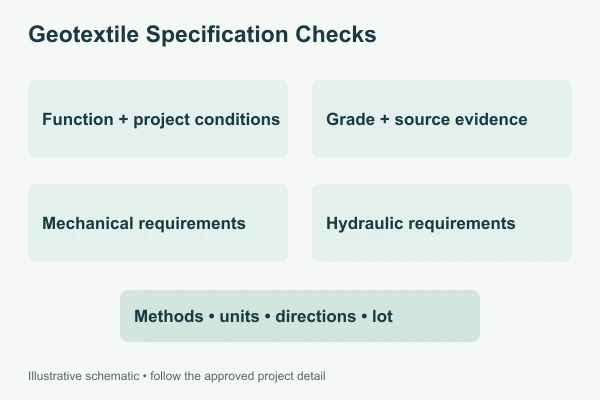
A strength schedule should make it possible for a reviewer to understand every number without searching through several unrelated brochures. Put the property, method, unit, direction, elongation and value basis on the same line.
Before approving an order:
- Identify whether the duty is survivability, separation or reinforcement.
- State the required wide-width or grab method explicitly.
- Require machine and transverse values where specified.
- Keep elongation with the associated tensile result.
- Confirm the statistical or acceptance basis.
- Include seam requirements and their separate evidence.
- Link the delivery lot to the approved grade and documents.
- Resolve any proposed test-method substitution in writing.
A practical procurement check is to highlight all strength units in the comparison sheet. If N, kN and kN/m appear in one ranking column, stop and separate the properties before evaluating price.
Send the specified methods and direction requirements with your project inquiry, so the requested evidence matches the proposed material.
References
Tech Note: A grab result in N is not a wide-width result in kN/m; changing the unit scale does not change the test geometry.