A Thicker Sample Is Not Automatically Better
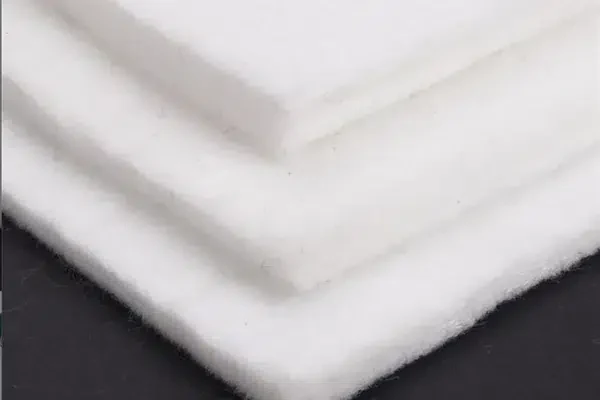
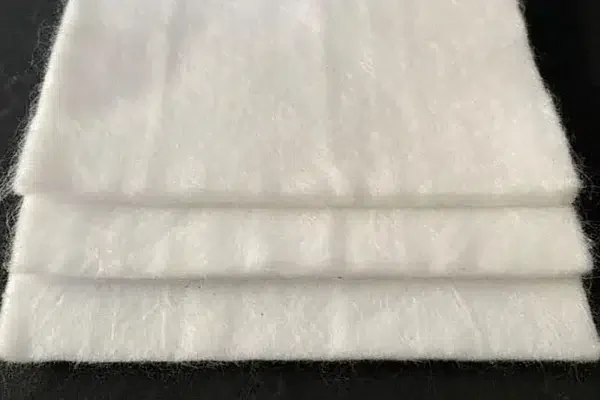
A soft nonwoven sample can feel thick in the hand and compress considerably after burial. Another fabric may feel thinner while providing the required tensile and hydraulic properties. Selecting by touch or an unloaded calliper reading can therefore produce an unreliable comparison.
Geotextile thickness belongs to a defined measurement condition. ASTM D5199 addresses nominal thickness and recognises the importance of the applied normal load. A reported thickness without its method and conditions is incomplete purchasing information. [2]
Begin with the function of the geotextile layer. Protection, filtration, separation and reinforcement impose different requirements. Thickness may help describe a product, but it does not replace the properties that control its duty.
The review is particularly important where a buyer receives several samples from different construction types. A fluffy needle-punched nonwoven and a woven fabric cannot be ranked simply by placing a ruler against their edges.
Compare the Declared Grade, Not an Isolated Dimension
The filament-polyester technical sheet lists BTF150 at 150 g/m² and 1.8 mm nominal thickness, BTF300 at 300 g/m² and 3.2 mm, and BTF500 at 500 g/m² and 4.4 mm. The same sheet identifies ASTM D5199 for thickness and separate methods for other properties. [1]
These values illustrate a particular product series. They should not be used as a universal conversion between fabric mass and thickness, nor as a prediction of thickness under the project’s actual confinement.
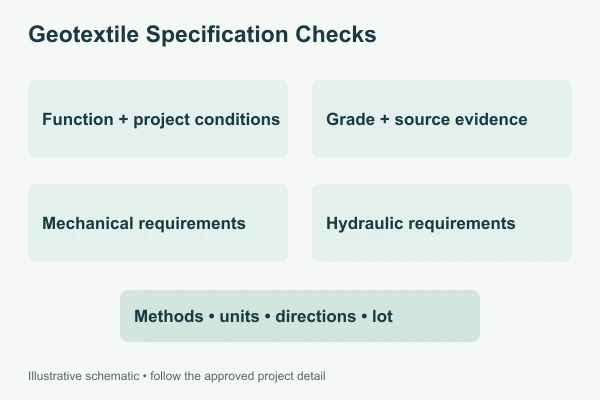
| Review item | Why it belongs in the comparison | Acceptance question |
|---|---|---|
| Nominal thickness | Describes the tested fabric geometry | Which method and pressure apply? |
| Mass per unit area | Identifies material quantity | What grade and tolerance are declared? |
| Mechanical properties | Support handling and survivability review | Are method, direction and value basis comparable? |
| Hydraulic properties | Support filter and drainage evaluation | Are flow and opening-size conditions appropriate? |
Where protection is required, examine the relevant puncture and system evidence. A thicker fabric is not a direct proof that a liner will remain undamaged under a particular aggregate and load. Where filtration governs, an apparently dense sample still needs suitable opening-size and flow information.
ASTM D5261 provides a separate mass-per-area measurement. Using the two measurements together can help identify a grade, but dividing one by the other does not by itself establish a design property or acceptance rule. [3]
Control Sample Handling and Field Placement
For incoming inspection, identify the grade, lot and sample condition before measurement. Agree how specimens are conditioned and tested. A wet, creased or heavily handled piece should not be casually compared with a clean laboratory specimen.
Avoid squeezing a fabric with an uncontrolled calliper and recording the result as the specified nominal thickness. Field checks can identify obvious discrepancies, but disputed conformity should follow the agreed test method and sampling procedure.
During installation, inspect the supporting surface and the materials that contact the fabric. Sharp protrusions and local voids can create concentrated contact conditions. Adding a nominal millimetre to the fabric specification does not justify leaving those defects unresolved.
Check overlaps and joins against the accepted detail. A thick edge folded several times can create a local irregularity beneath a liner or another thin layer. The joining method should preserve the intended function without introducing avoidable ridges or exposed gaps.
Record any product substitution before placement. A supplier may offer another fabric with similar thickness but a different mass, polymer, construction or tensile response. That is a technical alternative requiring comparison, not a simple change of packaging.
For critical interfaces, inspect and photograph the installed condition before covering. The most useful evidence often concerns surface preparation, continuity and damage control rather than one thickness reading.
Compare Samples Under the Same Conditions
Consider two thickness reports produced under different stated conditions. Keep the difference visible and request comparable evidence where thickness governs acceptance. Do not choose whichever report happens to show the larger value, or average the two results into a new figure that belongs to neither test.
For a site sample, record whether it came from an unopened roll, a handled edge or an installed area. Creasing, contamination and prior compression can affect how useful that sample is for the intended comparison. Follow the agreed sampling and testing procedure when conformity is disputed.
The supplier and reviewer should also confirm that the sample represents the proposed construction. A similar-looking nonwoven from another series may have a different mass, bonding process or property schedule. Retain the sample identification with the technical submission. This prevents a tactile demonstration in a meeting from becoming an unsupported acceptance criterion in the purchase order.
Assess Durability and Installed Cost by Function
Extra thickness can increase transport volume and handling requirements. It may be justified where the relevant performance evidence supports the application, but it should not be purchased as an undefined safety margin.
Compare the full accepted specification at the same delivery and installation basis. If a thinner alternative meets the required properties and installation conditions, its lower bulk may have commercial value. If it lacks the required evidence, a smaller quoted price does not establish equivalence.
For a protected geomembrane system, evaluate the liner, contact materials, loading and cushion together. System behaviour depends on the arrangement, including defects and local contact points that a nominal fabric dimension cannot describe.
Long-term performance also requires attention to polymer suitability, environmental exposure and the intended function. Do not infer a fixed service life from thickness alone. Where compression under sustained load matters, request relevant evidence instead of treating an unloaded sample as the installed condition.
Cost comparisons should include rejected material, repair and access for replacement. A material selected on an incomplete thickness label can become expensive when the discrepancy is discovered after other layers are installed.
Write a Thickness Requirement That Can Be Checked
If thickness is an acceptance property, state the method, required value, value basis and sampling arrangement. Keep it alongside the controlling functional properties rather than making it the only line in the specification.
Before ordering:
- Confirm the material function and adjacent layers.
- Identify polymer, construction, grade and mass.
- State the nominal-thickness method and conditions.
- Separate catalogue values from lot conformity results.
- Compare relevant strength, puncture and hydraulic properties.
- Agree sample identification and dispute handling.
- Review joining and local surface irregularities.
- Obtain written acceptance for any alternative grade.
An effective comparison records what is known and what still requires evidence. Leaving a pressure or method field blank is preferable to silently inventing a condition that makes two products appear equivalent.
Send the functional requirements and thickness specification with your technical inquiry, including the drawings where the fabric interfaces with other materials.
References
Tech Note: A nominal thickness belongs to its stated test condition; do not present it as the fabric’s guaranteed thickness under every installed load.