A Free-Draining Fabric Can Still Be the Wrong Filter
Water passing through a sample does not prove that the same geotextile will work against the project soil. The filter needs sufficient water passage, suitable particle retention, and a construction method that preserves both. Reviewing only the largest flow number leaves the soil interface unresolved.
Geotextile permittivity is useful because it describes water passage through the thickness of the fabric. It belongs alongside opening-size information and soil compatibility, rather than replacing them. ASTM D4491 identifies the laboratory measurement; ASTM D4751 addresses apparent opening size. [2][3]
Begin the drainage submittal with the soil grading, expected water conditions, and position of the fabric. A wrapped aggregate drain, a retaining structure interface, and a filter below erosion protection do not necessarily have the same requirements.
The geotextile product page helps identify candidate materials. Approval should follow the project’s filter criteria and the actual test documentation for the proposed grade.
Keep Permittivity, Permeability and Flow Rate Separate
Permittivity is normally expressed in s⁻¹. A hydraulic conductivity or permeability coefficient uses a length-per-time unit, while flow per unit area can be reported in L/m²/s. These quantities cannot be ranked as though their numbers represent the same measurement.
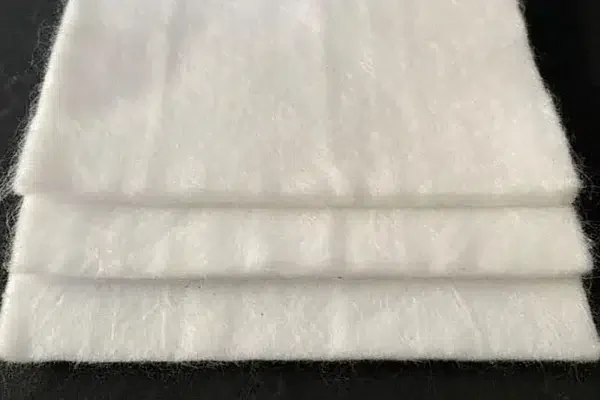
For example, the filament-polyester sheet lists BTF200 at 200 g/m², 2.3 mm nominal thickness and a Water Flow Q100 value of 220 L/m²/s. The listed flow value should remain under its stated label. It is not a permittivity value of 220 s⁻¹. [1]
If a conversion is proposed, require the test head, specimen condition and calculation basis. A head-normalised quantity cannot be derived reliably from a catalogue flow number when the relevant test conditions are not confirmed. ASTM D4491 also distinguishes laboratory conditions from field performance. [2]
| Reported item | Typical unit | Review question |
|---|---|---|
| Permittivity | s⁻¹ | Which procedure and specimen condition were used? |
| Hydraulic conductivity | m/s or cm/s | What thickness and measurement basis apply? |
| Flow per unit area | L/m²/s | What hydraulic head produced the reported value? |
| Opening size | mm or sieve designation | Which method and opening percentile are stated? |
Opening labels need equal care. A source sheet labelled O90 should not be silently treated as an O95 or ASTM apparent-opening-size result. Ask the laboratory or supplier to resolve the designation before comparing competing submissions. The issue is comparability, not whether one number happens to look smaller.
Inspect the Soil Contact and the Drainage Path
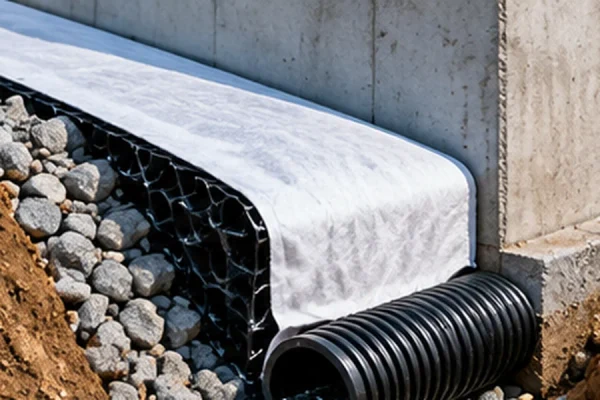
Prepare the receiving surface so the fabric remains in close, continuous contact where the design requires it. Large voids, loose clods, and unsupported corners can change the local movement of soil and water.
Check roll orientation, joins and terminations before placing drainage aggregate. Soil must not bypass the fabric at an unprotected edge or enter through a damaged wrap. Pay particular attention to pipe penetrations and changes in section, where a simple flat-sheet detail may not describe the installed arrangement.
Keep the material clean during storage and placement. A suitable fabric contaminated by mud before installation starts with a different condition from the submitted laboratory sample. Segregate dirty or damaged rolls and follow the accepted assessment and repair procedure.
Verify that the downstream drainage route remains open. Selecting a high-permittivity fabric cannot correct a blocked pipe, an omitted outlet, or a drain installed without the required fall. Inspect the system as a connected route from the soil interface to the discharge point.
An effective field record includes the approved grade, roll identification, photographed terminations, joint checks, and the condition of the material before covering. Record deviations while they remain visible, rather than relying on an end-of-project checklist.
Resolve a Mixed-Unit Comparison Before Approval
Consider two submissions: one states permittivity, while the other lists a water-flow value under a named head. Do not let a spreadsheet rank them automatically. Add columns for the quantity definition, unit, test procedure and condition, then request the missing information before deciding whether a valid comparison is possible.
Review the opening-size labels in the same way. The supplier should identify the reported designation and its laboratory basis; the buyer should identify the project criterion. The review then connects those two records rather than assuming every opening-size number expresses the same percentile or procedure.
This clarification can be completed before the quantity order is released. Keep the agreed response in the technical submission and use the same terminology in the purchase schedule. If the incoming certificate later uses another label, resolve that discrepancy before the material is covered. A clean document trail makes the acceptance decision easier to reproduce.
Evaluate Long-Term Flow and the Cost of Access
The initial laboratory number is only part of the drainage question. Soil compatibility, confinement, installation damage and the actual water environment can affect service performance. Select additional testing where the design calls for it; avoid assuming a mass or thickness increase automatically solves clogging.
For a buried drain that is difficult to reach, an incomplete technical review can create a disproportionate maintenance cost. Excavation, removal of finishes, interruption of operations and disposal may exceed the original fabric price.
Compare quotations against the same acceptance package. A lower price based on an unqualified flow value is not directly comparable with a quotation that includes the required opening-size and hydraulic reports.
Where the project needs water to travel within the plane of a drainage core, examine a drainage geocomposite rather than treating a geotextile’s through-thickness flow as equivalent. The filter and the conveyance layer solve different parts of the drainage system.
Avoid assigning a service-life number from one isolated hydraulic test. State the project conditions, maintenance access and evidence required for the intended drainage duty.
Build a Submittal That Can Be Compared
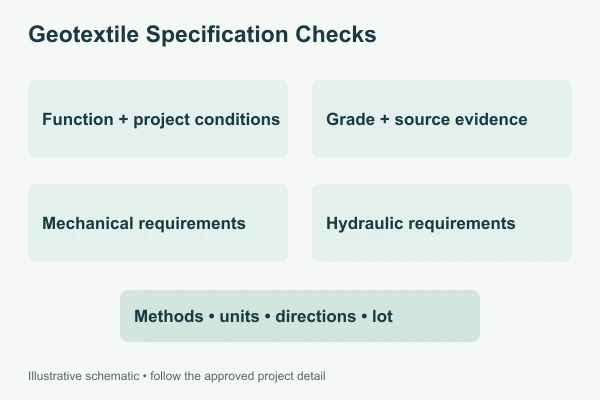
Ask the designer to identify the governing filter criteria before collecting product data. Then place every candidate in the same comparison table, with units, methods and source documents visible.
The submission should include:
- Soil grading and relevant hydraulic conditions.
- Proposed material, polymer, construction and grade.
- Permittivity or flow data with the full measurement basis.
- Opening-size method and designation.
- Required mechanical survivability properties.
- Joining, wrapping, termination and repair details.
- Drainage route, outlet arrangement and inspection access.
- Lot identification and the required conformity records.
If the source document does not provide a required condition, request it explicitly. Replacing a missing test head or opening designation with an assumed value can make a comparison look complete while leaving the decision unsupported.
For purchasing, identify which documents are required before approval, which accompany delivery, and which are verified on site. This avoids discovering at dispatch that the laboratory evidence differs from the project submission.
Use our contact page to send the drainage detail and test requirements with the quantity request.
References
Tech Note: Leave a catalogue flow value in its original unit until the test conditions support a valid conversion; never compare L/m²/s directly with s⁻¹.