The Panel Cannot Correct an Unsuitable Foundation
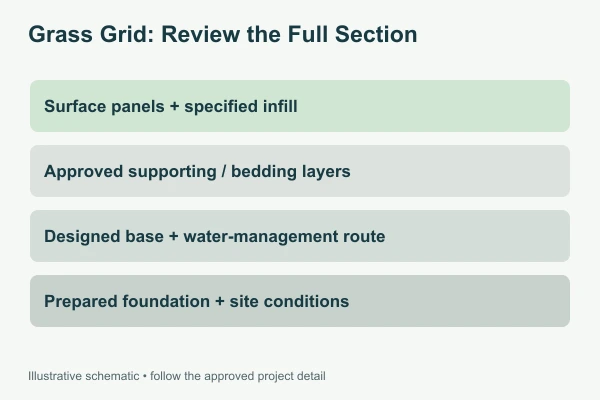
Grass grid installation needs a complete surface and foundation detail. A panel with an impressive compression number can still be unsuitable for a site if the supporting layers, drainage, traffic or establishment conditions are unresolved.
Begin with the intended use: occasional access, parking, emergency access or another defined traffic duty. Then assess the ground, water route, turning and braking movements, vegetation requirements and maintenance resources.
The panel helps form the surface arrangement, but its material rating does not independently establish the capacity or infiltration performance of the completed pavement. The accepted section and relevant performance requirements need to be identified before procurement.
Use the product overview and the available grass-paver technical information as the starting point, then request a proposal tied to the actual site rather than a generic “heavy-duty green grid”.
Distinguish Panel Data from Completed-System Performance
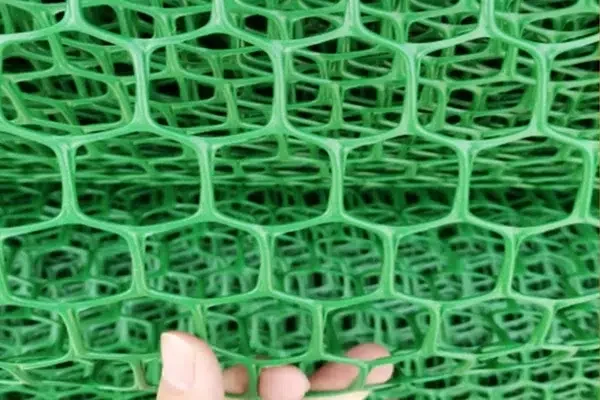
The supplied grass-paver sheet identifies an HDPE product family and lists a load-bearing figure of 160–200 ton/m². That catalogue figure should not be treated as an approved axle load or a traffic classification without its test arrangement, support condition and applicable design evidence. [1]
Confirm the panel dimensions, joining system, material option and tolerances for the offered supply. Do not infer physical dimensions solely from a model code or from a table that omits the dimensional unit.
| Design or supply item | What to establish | What a panel number cannot prove |
|---|---|---|
| Traffic duty | Vehicle types and operating conditions | Whole pavement capacity |
| Foundation and base | Accepted materials and section | Suitability of weak or saturated ground |
| Water management | Infiltration, storage or discharge arrangement | Effective drainage under all site conditions |
| Surface infill | Material and vegetation requirements | Successful establishment without maintenance |
| Panel and edges | Offered geometry and restraint detail | Stability with unreviewed boundaries |
Permeable pavement requires an appropriate water-management and maintenance approach. Surface openings alone do not demonstrate that the underlying ground can accept the required flow or that a discharge route is unnecessary. [2]
Keep structural acceptance, drainage acceptance and vegetation establishment as separate checks. Combining them into one “panel strength” field hides the requirements that the installation team must actually meet.
Inspect the Base and Boundary Details Before Filling
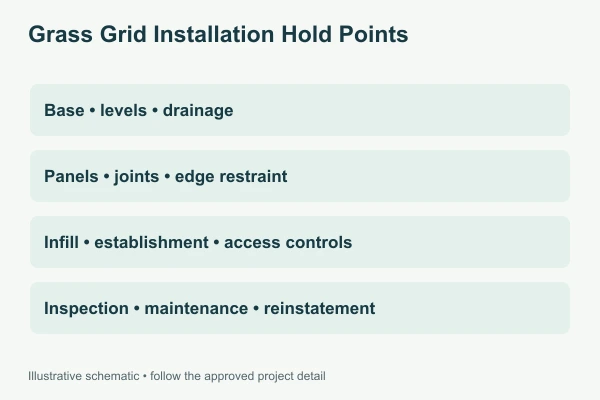
Set out the area, drainage features, transitions, service covers and edges before installation. Confirm the foundation and supporting layers against the approved section. Resolve soft spots, unexpected water and level differences before panels conceal the surface.
Install any specified geotextile separator or filter according to its own function and joining requirements. It should not be added or omitted merely because a general landscaping detail shows a fabric layer.
Lay panels with the accepted orientation and joining arrangement. Check the first area for fit, level and boundary control before continuing. Cut panels at transitions using the supplier’s accepted method, and avoid leaving unsupported small pieces where traffic can disturb them.
Inspect edge restraint and interfaces with hard paving, drains and covers. These details can influence movement and local loading, especially where vehicles turn or brake. A uniform field of panels does not describe the behaviour of every boundary.
Place the specified infill using the accepted sequence and level. Overfilling or leaving inappropriate exposed edges can change traffic contact and vegetation conditions. Follow the project and supplier requirements rather than selecting a universal fill depth from an unrelated installation.
Where vegetation is required, establish the agreed opening-to-traffic criteria and maintenance plan. Confirm the responsibilities for watering, soil condition and repair of poorly established areas. A completed panel layout is not the same milestone as an established grass surface.
Coordinate the Contractor and Landscape Handover
Consider an area where the paving contractor installs the panels and another team completes the infill and grass establishment. Agree the handover condition and responsibility before the first area is released. Otherwise, each team may assume the other is responsible for levels, infill correction or early maintenance.
Record the accepted panel condition, boundaries, drainage features and any restrictions on access during establishment. Identify who checks the surface before opening it to the intended traffic.
Include a practical response for local settlement, poor vegetation and disturbed edges. The maintenance team needs the accepted product and section information to reinstate the arrangement correctly. Replacing a damaged patch with another panel or an arbitrary infill can change the original detail. A clear handover connects installation acceptance to ongoing use without promising that a planted surface will remain unchanged under every traffic and weather condition.
Compare Installation and Maintenance Costs Together
The installed cost includes preparation, supporting layers, drainage, panels, edges, infill, establishment and maintenance. A low price per panel can conceal missing work in the base or water-management system.
For an illustrative quantity estimate, a 500 m² net area with a separately assumed 4% cutting and reserve allowance gives 520 m² gross panel demand before pack rounding. The 4% allowance is an example, not a standard requirement; derive the actual figure from the layout and panel dimensions.
Do not convert panel compression data directly into a guarantee for vehicle movements. Compare offers using the same accepted traffic, foundation and drainage assumptions, with product-specific evidence where required.
Maintenance needs depend on traffic, vegetation, weather and the water-management arrangement. Plan how sediment, damaged panels, local settlement and weak grass areas will be identified and addressed.
For high-use or specialised access areas, confirm that the surface and maintenance approach suit the intended operation. A proposal that assumes ideal grass establishment and occasional traffic may not address frequent turning, parking or service loading.
Keep any service-life statement tied to documented conditions and evidence. Polymer identification and a catalogue compression figure do not establish an unconditional lifetime for the completed surface.
Issue a Complete Installation and Establishment Package
The purchasing package should identify the accepted panel and the work needed around it. Make the responsibilities clear before delivery, particularly where the paving contractor and landscape team perform different stages.
Include:
- Intended traffic and accepted section requirements.
- Confirmed panel geometry, material and joint system.
- Product test basis and required conformity records.
- Foundation, supporting layers and drainage details.
- Edges, transitions and service-cover interfaces.
- Specified infill and vegetation arrangement.
- Installation checks and opening-to-traffic criteria.
- Establishment, inspection and maintenance responsibilities.
Ask suppliers to identify unresolved test or dimensional information before the order is released. A table with missing units should lead to a clarification, not a guessed dimension inserted into the installation drawing.
Send the intended use, layout and foundation information through our project inquiry page for a specification-based discussion of the panel and documentation package.
References
Tech Note: Accept the base, drainage and edge details before filling the panels; the catalogue compression figure does not certify the completed grass-grid pavement.