Keep the Aggregate and the Soil in Their Intended Layers
A separation layer is selected to help prevent the subgrade and aggregate from mixing. If the fabric is torn, displaced or bypassed during placement, aggregate can become contaminated even when the delivered material matches the approved data sheet.
The geotextile separation layer therefore needs both a suitable material specification and a controlled installation method. Begin with the soil condition, aggregate grading, placement equipment and expected construction loading. A product described as “road fabric” does not answer these questions on its own.
Separation must also be distinguished from structural reinforcement. A fabric can help maintain layer integrity without independently establishing the pavement thickness or bearing capacity required by the design. Those decisions require the relevant ground and loading assessment.
Use the geotextile range to identify candidates, then review the properties and installation details required for the actual road, access route or working area.
Define Survivability and Hydraulic Requirements Together
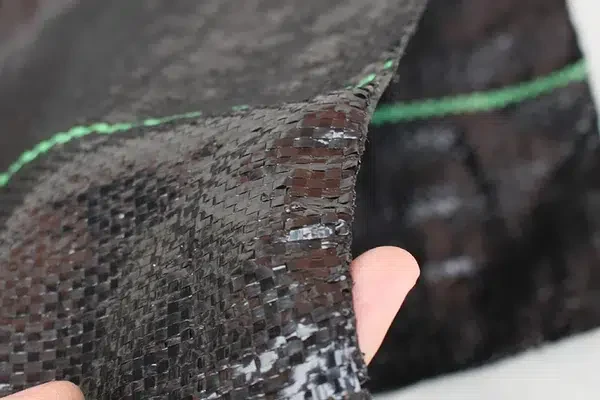
The supplied PP woven sheet lists BTW20-15 with 20 kN/m machine-direction break strength, 15 kN/m cross-direction strength and 120 g/m² unit weight. BTW40-28 is listed at 40 kN/m, 28 kN/m and 200 g/m². These are product-series values; test-method and lot-conformity evidence should be confirmed against the project requirement. [1]
A higher mass does not by itself establish better separation performance. Review the required tensile, tear and puncture properties, together with the opening-size and hydraulic criteria relevant to the soil interface.
ASTM D6241 provides a static puncture index test. ASTM D4751 addresses apparent opening size. Their results support different parts of the review and should not be substituted for one another. [2][3]
| Selection input | Material or installation consequence | Required review |
|---|---|---|
| Weak, irregular subgrade | Greater risk during initial placement | Preparation and construction sequence |
| Angular aggregate | Concentrated contact with the fabric | Survivability evidence and placement method |
| Fine soil with water movement | Potential migration through or around the layer | Filter compatibility and edge continuity |
| Heavy construction traffic | Demand on the complete unbound section | Approved cover and traffic method |
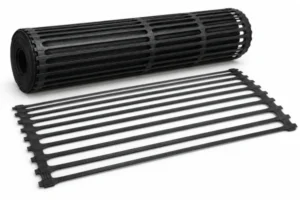
Where another geosynthetic is specified for reinforcement, review the functions separately. A geogrid does not automatically supply the filtration or separation function of a fabric, and adding a geotextile does not establish the grid’s design performance.
Treat the First Aggregate Lift as a Critical Check
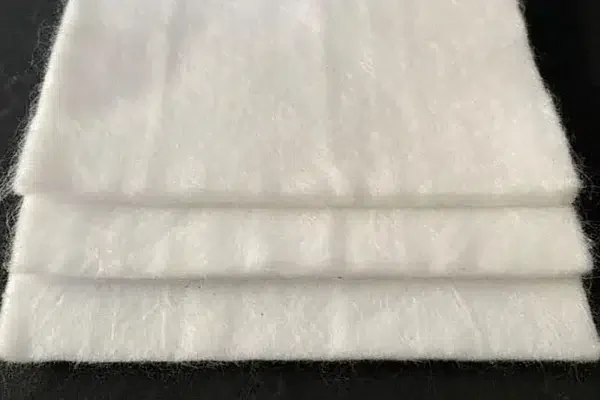
Inspect the prepared surface before unrolling. Remove debris and identify unstable areas that need treatment under the approved earthworks method. The fabric should not be used to conceal ground conditions that differ materially from the design assumptions.
Lay the geotextile without unnecessary tension, following the surface and the required joining arrangement. Mark overlap or seam requirements on the work plan. The accepted dimensions may depend on the ground, material and installation conditions; do not apply one catalogue overlap to every project.
Plan aggregate delivery so the advancing placement front does not pull joints apart or fold the fabric. Observe the first section and check the method before repeating it across the entire area. Maintain the equipment restrictions and cover requirements stated in the approved procedure.
Do not permit direct trafficking on exposed fabric unless the project’s accepted method specifically allows the arrangement. The fact that a roll has a high tensile value does not mean it can withstand every tyre, track or sharp turning movement.
Inspect visible movement, tears and contaminated areas before covering. Repairs should follow the approved detail, with the location and extent recorded. Where the fabric is no longer continuous, adding more aggregate without review leaves the separation function unresolved.
Keep roll and lot identification linked to the installation zones. A photographed pre-cover inspection is useful when it identifies the grade, location and actual condition, rather than showing an anonymous sheet on the ground.
Respond to an Unexpected Soft Area
Consider a prepared zone that becomes wetter or softer than the condition used in the accepted method. Identify and record the affected area, then obtain the required earthworks or design review before continuing the same placement sequence. The geotextile should not be treated as a universal repair for every changed ground condition.
Check whether the installation equipment, aggregate source or spreading method also differs from the approved arrangement. More than one change can be present, and replacing the fabric alone may not address the cause of movement or damage.
Retain the accepted response with the installed-zone record. Include any revised preparation, material or equipment requirements, and confirm that the site team uses the updated instruction. This connects the separation function to the actual conditions beneath the covered layer rather than to an earlier drawing assumption that no longer describes the work.
Compare Material Price with Contamination and Rework Risk
The commercial benefit of a separation layer depends on maintaining the designed aggregate and soil arrangement. Paying less for a fabric that cannot survive the planned installation can increase replacement, aggregate loss and rework costs.
Compare offers against the same functional requirements. Include usable coverage, joins, handling, delivery sequence and the required documentation. A cheaper roll with a different construction type or incomplete hydraulic evidence is an alternative requiring assessment, not an automatic equivalent.
Consider how the material is stored and exposed before covering. Protect rolls from avoidable damage and contamination, and follow the applicable handling instructions. Long-term buried behaviour and temporary exposure are separate questions.
The fabric does not remove the need for drainage. If water has no suitable route out of the section, a separation layer alone cannot correct the site’s drainage problem. Coordinate the section with the project’s water-management details and any specified drainage geocomposite.
Avoid quoting a universal percentage reduction in aggregate thickness or maintenance cost. Such claims need the design basis, project conditions and supporting evidence for the proposed system.
Approve the Material and the Work Method as One Package
The purchasing schedule should reference the accepted grade and the construction method that the grade is expected to survive. If the aggregate, equipment or ground conditions change, review the implications before continuing.
Use this pre-placement checklist:
- Confirm the ground condition against the project assumptions.
- Identify the fabric’s separation and any additional filter function.
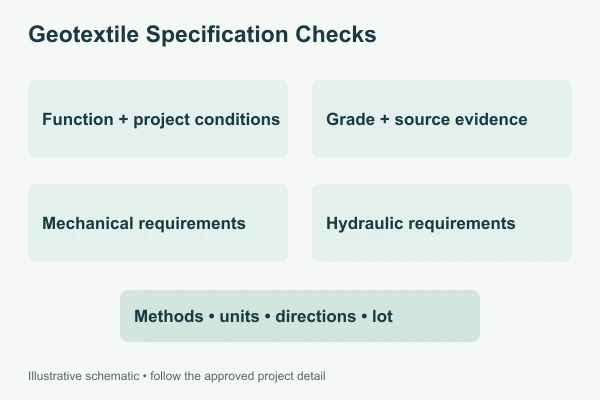
- Review the required mechanical and hydraulic test evidence.
- Confirm roll orientation, joins and terminations.
- Agree aggregate delivery, spreading and equipment controls.
- Set pre-cover inspection and repair requirements.
- Retain grade, lot and installed-zone traceability.
- Obtain approval for material or work-method substitutions.
Request the applicable test method whenever a data sheet lists a property without one. A value and unit are useful starting information, but the laboratory basis and acceptance condition determine whether it meets the project specification.
Send the road section, soil information, aggregate details and quantity to our project inquiry page for a specification-based product discussion.
References
Tech Note: Check the first aggregate placement for fabric movement and damage before repeating the same method across the site.