A Test List Needs to Follow the Application
A long list of test standards can make a geogrid submission appear complete while leaving the controlling requirement untested. Tensile strength, junction behaviour, soil interaction and installed-system performance answer different questions.
Geogrid testing should begin with the intended function and acceptance criteria. Identify the properties the design uses, the evidence required for product approval, and the lot checks needed at delivery. Then request a test schedule that connects each result to a decision.
This is particularly useful when several geogrid constructions are being compared. An extruded polymer grid, a coated textile grid and a fiberglass grid may not share the same relevant behaviour or application.
Do not assume a familiar standard number establishes that the laboratory tested the offered product. Check the grade, specimen identification, report date and the relationship between the sample and the proposed supply.
Distinguish Tensile, Junction and Interface Evidence
ASTM D6637 addresses tensile properties of geogrids. ASTM D7737 addresses individual junction strength. A grid may have a tensile result without having the junction or interface evidence required for a particular project. [2][3]
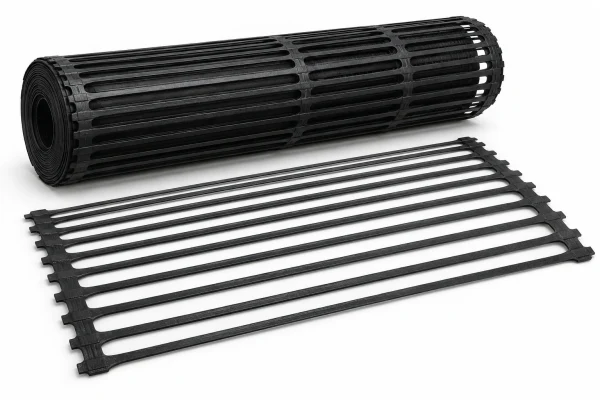
The fiberglass technical sheet lists BFD50-50 with longitudinal and transverse tensile strengths of at least 50 kN/m and a series elongation limit of 4%. Those are product-data values; the applicable test report is needed to confirm the method and conformity basis for an actual submission. [1]
| Evidence category | Primary question | Required identification |
|---|---|---|
| Tensile testing | How does the specimen respond to tension? | Method, direction, grade and force–strain basis |
| Junction testing | What is the tested connection between ribs? | Junction type and test arrangement |
| Soil or aggregate interaction | How does the interface behave in the assessed condition? | Product, fill, confinement and relevant conditions |
| Long-term evidence | What resistance applies over the design period? | Product-specific factors and environment |
| Installed-system evaluation | How does the assessed section perform? | Full section, loading and construction basis |
If two reports use different methods or specimen arrangements, list that difference rather than forcing both results into one ranking column. Equivalent-looking units do not prove equivalent measurements.
Request the relevant force–strain information where the design limits deformation. An ultimate tensile result alone does not show the force available at every lower strain.
Link Laboratory Results to Delivery and Site Checks
Agree the sampling plan and acceptance criteria before material is dispatched. Identify who samples, how samples are marked, which directions are tested, and how disputed results are handled.
On receipt, match roll labels and lot information with the approved product schedule. Retain certificates and test reports with enough detail to identify the actual delivery. A generic brochure is not a substitute for the specified conformity documents.
Inspect storage and handling for damaged ribs, distorted panels or other visible problems relevant to the product construction. Record suspect material and use the agreed assessment procedure before it is installed.
During placement, check orientation, joins, layer position and the aggregate or soil being used. Laboratory evidence generated with one fill or installation arrangement may not support an unreviewed change on site.
Where a project requires trial sections, field performance checks or inspection hold points, include them in the work programme. A complete laboratory report does not remove these requirements.
For reinforced structures, verify any facing or connection components against the accepted system. A report for a grid tested with one component should not be presented as evidence for an unmatched connection.
Keep photographs, inspection sheets and delivery identifiers connected by installed zone. This makes later investigation possible without relying on the appearance of buried material or an unlabelled sample retained in the office.
Check the Laboratory Instruction Before Sampling
Consider a laboratory order that requests a tensile test but omits the required direction and value basis. Resolve those omissions before specimens are cut and dispatched. A complete report for the wrong comparison can consume time without advancing the approval.
Provide product identification, the requested method, relevant directions and the project acceptance question. Agree how samples are labelled and how the laboratory records any departure from the requested arrangement. Keep those instructions with the resulting report.
When the report arrives, compare its scope with the original request before copying values into the compliance schedule. If a field is absent, ask for clarification rather than assuming it matches the project. This check is especially useful where several grid constructions are supplied together. The report should identify which material and tested property it actually covers, with no need to infer the answer from a filename.
Compare the Full Testing and Approval Cost
Testing has cost and lead-time implications. A quotation that excludes required conformity testing or additional evidence may look cheaper than a compliant offer while postponing the cost until after the order.
Ask bidders to distinguish existing product evidence from tests that still need to be performed for the project. Record laboratory availability, sample quantity and the programme for results where these affect delivery or installation.
Long-term requirements need the appropriate product-specific evidence. GRI-GG4 addresses a framework for long-term geogrid design strength; it is separate from a simple incoming tensile check. [4]
Do not replace missing durability or creep information with an arbitrary universal factor. Where the proposed application requires such evidence, resolve the requirement with the designer before accepting the alternative.
Also consider the cost of rejected or untraceable material. Replacement transport, standby equipment and rework can exceed the price of a properly planned test package.
For projects involving several geosynthetics, use a coordinated material schedule but retain a separate test and acceptance basis for each function. A geomembrane or geotextile certificate cannot establish grid conformity.
Prepare a Test Matrix Before Ordering
A useful matrix puts the required property, method, value basis, sampling frequency, evidence stage and responsible reviewer on the same line. That prevents one party assuming another has checked an important condition.
Include:
- Application and accepted product grade.
- Required tensile directions and strain levels.
- Junction, interface or connection evidence where applicable.
- Long-term design documentation where required.
- Lot conformity and delivery identification.
- Sampling, laboratory and dispute procedures.
- Site installation checks and hold points.
- A clear process for approving substitutions.
Check that every report refers to the proposed construction and relevant conditions. Where a method is not stated in the catalogue, request the original laboratory basis instead of adding a standard number by assumption.
Send the project’s test matrix through our inquiry page with the proposed grade and quantity, so documentation requirements are visible before the commercial offer is finalised.
References
Tech Note: A tensile report, a junction report and a system-performance report answer different questions; match each required decision to its own evidence.