Do Not Use the Ultimate Grade as the Design Resistance
A geogrid labelled with a high tensile grade can look reassuring in a purchasing schedule. The design still needs to know the relevant direction, strain response, value basis and long-term resistance for the actual application.
Geogrid tensile strength is therefore a starting property, not a complete design conclusion. A short-term ultimate value should not be copied directly into a sustained reinforcement calculation or used to approve a substitute without the required evidence.
The first distinction is functional. A reinforced soil structure with sustained tensile loading and an aggregate stabilisation layer may use different design approaches and evidence. The product family alone does not tell the reviewer which property controls.
Begin with the accepted design requirements and the specific geogrid construction proposed for supply. Then separate ultimate strength, low-strain response, connections and long-term design properties into their own fields.
Read the Full Force–Strain and Directional Schedule
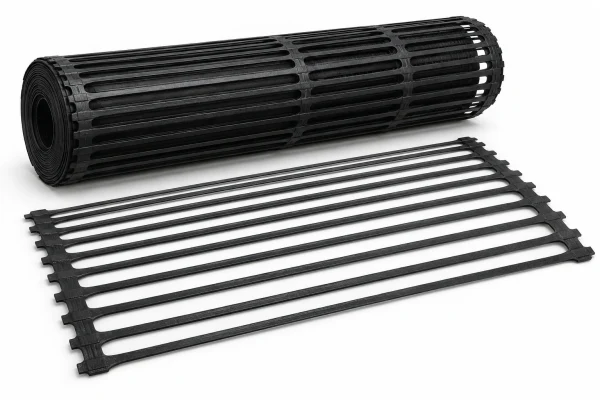
The uniaxial data sheet lists the HDPE BGUG50 grade with tensile strength of at least 50 kN/m, strength at 2% elongation of at least 10 kN/m and strength at 5% elongation of at least 25 kN/m. Confirm the offered grade, direction and test-report basis before applying these figures. [1]
The three values describe different points or properties. A specification asking for strength at a limited strain cannot be satisfied merely by quoting the ultimate figure. Nor does a low-strain value independently establish the long-term design resistance.
ASTM D6637 addresses geogrid tensile properties. Report the method, direction, specimen arrangement and the declared acceptance basis with the result. Avoid comparing a nominal supplier grade with a statistically defined design or conformity value without clarification. [2]
| Property | What it helps describe | What it does not establish alone |
|---|---|---|
| Ultimate tensile strength | Short-term tensile limit under the stated test | Long-term design resistance |
| Strength at specified strain | Force mobilised at that strain | Every service deformation condition |
| Junction strength | Performance of the tested junction | Entire reinforcement-layer resistance |
| Connection strength | Behaviour of the tested connection arrangement | Performance of unmatched components |
Request complete directional information where the design needs it. A principal-direction value should not be silently assigned to the transverse direction because the product is supplied in a convenient roll width.
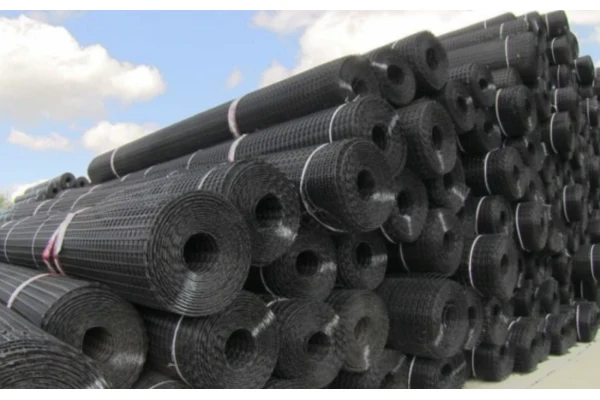
Keep Design Direction and Product Traceability Intact
The installation drawing should show the required reinforcement direction, layer position and extent. Cutting or rotating rolls to reduce waste must not change the load path assumed by the designer.
Check the supporting surface and the placement sequence before installing the grid. Avoid folds, local damage and discontinuities that undermine the intended arrangement. Use the accepted handling and fixing method for the actual construction type.
Where connections to facing units or other components are required, identify the matched products and accepted detail. A tensile report for the grid cannot substitute for evidence concerning a different connection system.
Retain the link between delivered rolls, manufacturing lots, approved technical documents and installed zones. An apparently similar grid from another construction series needs its own assessment; the printed strength grade may conceal differences in polymer, coating or response.
Inspect the first fill placement for displacement and damage. If the aggregate, equipment or installation procedure changes, review whether the evidence used for installation-damage considerations remains relevant.
A practical QC check is to place the drawing direction arrow, roll label and test-report direction next to each other during the first installation inspection. This can reveal a misunderstanding before the reinforcement is buried.
Review a Substitute Against the Same Design Basis
Consider an alternative with a higher ultimate grade but incomplete long-term documentation. Keep it in the comparison as an unresolved proposal rather than assigning it the accepted resistance of the original product. The missing evidence cannot be supplied by the larger printed number.
Ask which polymer, construction, conditions and test programme support the proposed design values. Check that any installation-damage basis relates to the actual fill and method. Where the designer accepts an alternative, record the specific product and evidence used, rather than only a generic strength class.
Update the installation schedule if the accepted substitution changes roll dimensions, direction marking or connections. The purchasing and construction consequences are part of the review. A technically accepted design property is useful only when the delivered and installed product can be identified as the same material covered by that acceptance.
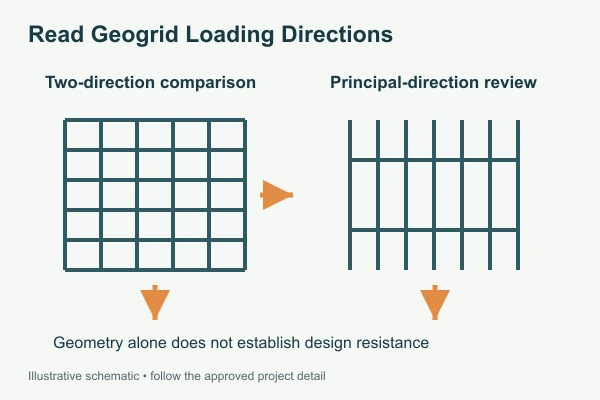
Use Product-Specific Long-Term Evidence
Long-term reinforcement resistance may require allowances for creep, installation damage and durability, according to the applicable design method. GRI-GG4 provides a framework for assessing long-term geogrid design strength. Factors must match the selected product and relevant conditions. [3]
As an arithmetic illustration only, a 100 kN/m starting value divided by assumed factors of 1.5, 1.2 and 1.1 gives approximately 50.5 kN/m. These factors are hypothetical and are not recommended design inputs. The example shows why a nominal 100 kN/m label cannot be treated as a final resistance.
The governing design procedure may require additional or differently applied factors. Follow that procedure rather than substituting the example into a calculation.
Commercial comparisons should use the accepted design property and documentation package. A product with a lower ultimate strength may compare differently after its verified long-term evidence is considered. Conversely, a high ultimate value with missing evidence can delay approval and installation.
Include connections, roll layout, handling, required testing and delivery traceability in the installed-cost comparison. The cheapest price per gross square metre is not necessarily the cheapest accepted reinforcement system.
Ask for the Property the Design Actually Uses
Put the required design and acceptance properties into a schedule before requesting quotations. Separate confirmed values from those awaiting review, and ask suppliers to identify any proposed departures.
The schedule should cover:
- Application and governing design procedure.
- Polymer, construction and proposed product grade.
- Ultimate strength with direction and value basis.
- Required low-strain tensile response.
- Product-specific long-term evidence and conditions.
- Connection or facing-interface requirements.
- Installation-damage assumptions and construction method.
- Lot conformity and traceability documents.
Where a separate filtration or separation function is needed, retain the appropriate geotextile requirements. The tensile grade of the grid does not establish those functions.
Send the required design properties and relevant drawings through our project inquiry page, rather than requesting only an ultimate-strength class.
References
Tech Note: Keep ultimate strength, strength at specified strain and accepted long-term design resistance in separate columns; they are not interchangeable ratings.