The Opening Must Be Reviewed with the Material Around It
Geogrid aperture size is often reduced to a catalogue dimension. In an aggregate-layer application, that dimension needs to be considered with particle grading, shape, placement and the selected grid’s mechanical response. The largest opening is not automatically the best opening.
The practical question is whether the proposed grid and aggregate form the interaction required by the design. A photograph of stone resting on a grid cannot establish that behaviour, and a nominal aperture dimension cannot describe every particle in a graded aggregate.
Begin with the application and the accepted design approach. For a reinforced soil structure, the relevant soil interaction and reinforcement direction may require a different review from a trafficked unbound layer.
Our geogrid range includes different constructions. Compare the candidate product with the actual aggregate source and section rather than borrowing an aperture recommendation from a different material family.

Record Clear Opening, Geometry and Relevant Mechanical Properties
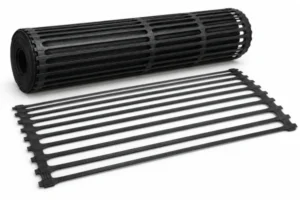
Aperture dimensions need a consistent definition. Ask whether the stated figure is a clear opening, a centre-to-centre spacing or a nominal manufacturing designation. Check both directions and the variation across the product where the specification requires it.
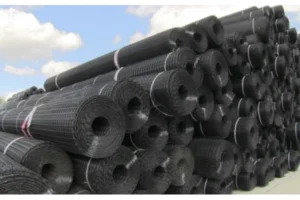
The fiberglass-geogrid sheet lists mesh options of 12.7 × 12.7 mm, 25.4 × 25.4 mm and 50.8 × 50.8 mm for its stated series. These are options for that construction; they are not a universal road-base aperture schedule. Confirm which size accompanies the offered grade and application. [1]
| Information | Why it changes the comparison | Evidence to request |
|---|---|---|
| Opening definition | Clear and centre spacing differ | Dimensioned product drawing |
| Aggregate grading | One nominal stone size hides a distribution | Proposed source grading report |
| Particle shape | Contact and placement behaviour vary | Aggregate description and relevant assessment |
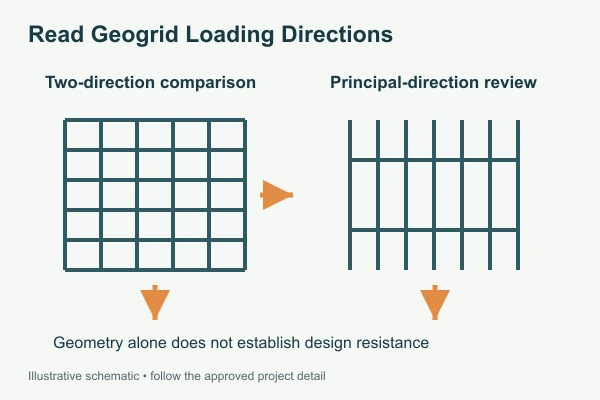
| Grid response | Geometry alone is incomplete | Required tensile, junction and interaction evidence |
ASTM D6637 and ASTM D7737 address tensile and individual junction properties respectively. Their results do not independently establish the performance of every aggregate-grid combination. [2][3]
Avoid an unsupported fixed aperture-to-stone ratio. If the project design or accepted performance evidence uses a relationship, identify its scope, aggregate definition and product basis. A ratio copied without those conditions can appear precise while remaining irrelevant.
For coated or woven grid constructions, also clarify how the opening is measured and how handling affects the geometry. Visual similarity does not make their response identical to an extruded grid.
Check Aggregate Supply and the First Placement Area
Confirm that the delivered aggregate matches the material assessed during approval. A change in quarry source, grading or particle shape should be reviewed before treating the existing geogrid acceptance as unchanged.
Inspect grid orientation, panel flatness and continuity before placing fill. Folded ribs and displaced panels can change the interaction at the interface. Follow the approved joining, fixing and equipment sequence rather than improvising around the available roll width.
Observe the first placement area. Check whether the grid stays in position, whether the aggregate is distributed as intended, and whether the construction method damages ribs or junctions. Use the specified inspection or performance checks; appearance alone cannot validate the structural design.
Keep oversized particles, debris and unreviewed fill out of the layer. A material described only as “crushed stone” may include a grading or shape different from the approved source.
Record the grid grade and aggregate delivery information by installed zone. This is especially useful when several fill sources or grid types are present on the same project.
Where separation or filtration is required, provide the specified geotextile layer. Open apertures do not prevent all fine-soil migration, and an aggregate-grid interaction requirement does not replace a filter review.
Control a Change of Aggregate Source
Consider a later delivery from a different quarry that is described by the same nominal aggregate size. Ask for the relevant grading and particle information rather than assuming the two sources are identical. The distribution of sizes and particle shape can differ within a shared commercial description.
Compare the new material against the basis used in the accepted grid proposal. Where the design or performance evidence requires a particular combination, obtain the necessary review before installation continues. Do not use a visual photograph of a few large particles as the complete grading check.
Retain the source change with the installed-zone record and the geogrid identification. This allows later work to use the correct accepted combination. The purpose is to preserve a reviewable interface, not to reject every supplier change automatically. A documented equivalence assessment is more useful than assuming that identical stone labels guarantee identical interaction.
Evaluate the Cost of the Accepted Combination
Compare the installed section, including aggregate availability and construction requirements. A grid that depends on a difficult-to-source aggregate may produce a different commercial result from a system assessed with locally available material.
Do not claim a fixed reduction in layer thickness or maintenance simply from an aperture change. Such a proposal needs the applicable design or performance evidence for the actual combination.
Long-term requirements should also match the material’s role. Where sustained tensile reinforcement is involved, the designer may require evidence beyond the aperture geometry and short-term index tests. Keep those requirements visible in the comparison rather than assuming they are covered by the product name.
A cheap substitution can become expensive if the aggregate source has to change, if additional verification is needed, or if installation must stop while missing evidence is obtained. Ask bidders to identify these dependencies before agreeing a unit rate.
For staged projects, retain the accepted aggregate and grid information for later deliveries. A new shipment with a familiar appearance should still be checked against the approved product and material schedule.
Put the Aggregate and the Grid in the Same RFQ
A useful RFQ contains the grid requirements and the aggregate information on which the proposal is based. Without both, suppliers may price different technical assumptions.
Include:
- Application, section and relevant loading requirements.
- Proposed aggregate grading, source and particle description.
- Required opening definition and dimensional tolerances.
- Grid construction, polymer and offered grade.
- Applicable tensile, junction and interaction evidence.
- Installation orientation, joining and traffic controls.
- Acceptance and sampling requirements.
- Procedure for reviewing changes in aggregate or product.
For quotations that show several mesh options, ask the supplier to identify one proposed option and explain the evidence supporting its use. A list of available apertures does not itself resolve the selection.
Send the aggregate grading and section with your project inquiry so the product review addresses the actual interface.
References
Tech Note: Confirm whether “aperture size” means clear opening or centre spacing before applying any comparison or project-specific relationship.