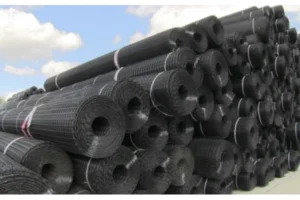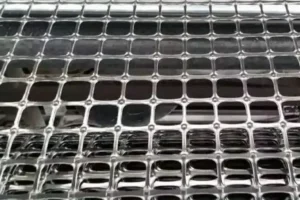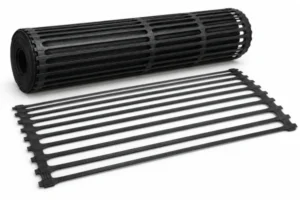
Identify Whether the Layer Needs Confinement or Planar Reinforcement
Geocell and geogrid can both appear in proposals for weak-ground access routes and aggregate surfaces. They should not be compared as two names for the same layer. Their geometry, installation sequence and required evidence differ.
In a geocell vs geogrid review, begin with the aggregate-layer problem. A geocell forms a three-dimensional cell system that contains infill. A geogrid is a planar reinforcement whose interaction with the surrounding material depends on the selected product and section.
Neither product name establishes the completed section’s bearing capacity or a universal reduction in aggregate thickness. The proposal needs ground information, loading, drainage and an applicable design method.
Consider whether the main concern is lateral movement of fill, deformation of an unbound layer, slope-surface containment or another specific mechanism. A clear function statement prevents a purchasing comparison from being reduced to price per square metre of plastic.
Compare Complete Systems and Their Technical Evidence
The geocell source sheet lists cell heights from 50 to 250 mm across its stated constructions. Its separate 100-685 textured-and-perforated example lists a 100 mm wall height and an expanded panel size of 5.08 m × 14.25 m. These describe a particular panel configuration; they do not establish a pavement design. [1]
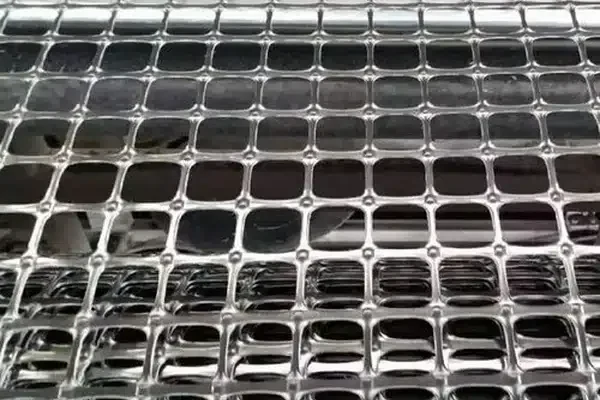
The biaxial geogrid sheet lists BGSG20-20 at 2% elongation with at least 8 kN/m longitudinal strength and at least 10 kN/m transverse strength. Those are different property types from geocell wall height or weld spacing. Confirm the proposed material and applicable test evidence before comparison. [2]
ASTM D8269 provides guidance on geocell use, while ASTM D6637 addresses geogrid tensile properties. The reference documents do not make the two materials automatically interchangeable. [3][4]
| Comparison item | Geocell system | Geogrid system |
|---|---|---|
| Geometry | Expanded cellular volume | Planar grid layer |
| Key material review | Cell height, wall construction, seams and connections | Tensile response, geometry and relevant interaction evidence |
| Installation input | Expansion, fixing, joining and infill sequence | Orientation, panel layout and aggregate placement |
| Quantity basis | Expanded area plus infill volume | Roll layout and approved overlaps or connections |
Review the supplied geocell and geogrid data with the same ground and loading assumptions. Comparing two unrelated catalogue applications cannot demonstrate which system suits the actual site.
Allow for Different Construction Sequences
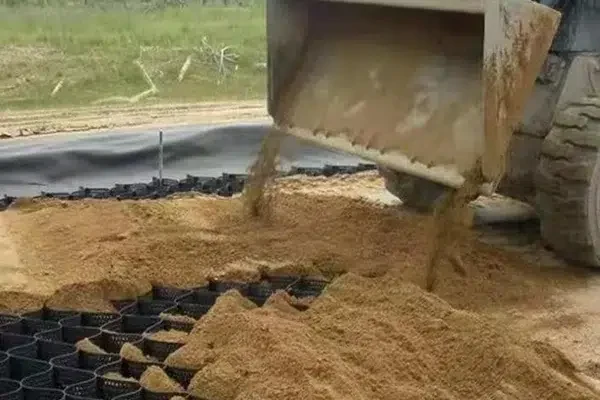
For geocell, confirm the expanded panel dimensions and cell geometry before fixing the system. Over-expanding or under-expanding a panel can change the intended arrangement and quantity. Check joints, perimeter restraint and infill placement while the cells remain visible.
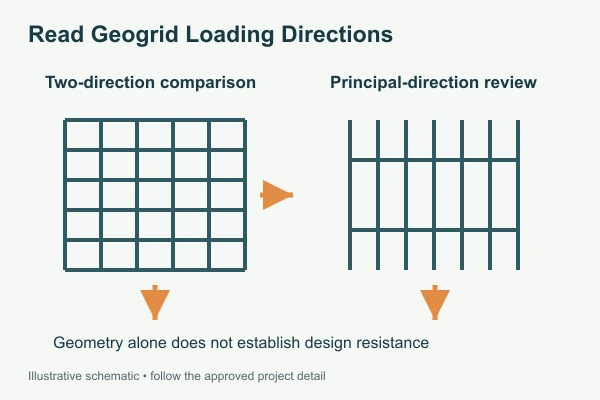
For geogrid, confirm roll orientation and continuity in the plane required by the design. The aggregate and placement method should suit the grid’s intended interaction with the layer. Avoid folds, displacement and unreviewed product changes.
Both systems require a prepared foundation and an accepted equipment sequence. Neither should be used to conceal ground that differs materially from the assumptions in the approved design. If wet or unstable areas appear, obtain the required assessment rather than simply adding a geosynthetic layer.
Drainage needs its own review. Geocell perforations do not automatically provide a complete drainage design, and geogrid apertures do not supply filtration. Where separation or filtering is required, consider the specified geotextile as a separate functional layer.
Use a trial installation or initial work section where the project requires it. Check actual handling, joining, aggregate placement and access before committing the full production sequence. Record deviations and the accepted corrective actions.
Make Alternative-Design Assumptions Visible
Consider two proposals that use different aggregate thicknesses or preparation requirements. List those differences before comparing their material prices. Otherwise, a geocell quote and a geogrid quote may appear to concern the same area while actually pricing different sections and performance assumptions.
Ask each proposer to identify which quantities follow from the accepted design and which are preliminary assumptions. Include infill, supporting layers, connections, drainage and the required verification. The buyer can then compare complete proposals rather than selecting a low geosynthetic rate from an incomplete bill of quantities.
If the project already has an approved section, record any departure as an alternative requiring the appropriate technical review. Changing the product name on the order does not update the design. Keep the acceptance decision with the final quantity schedule so a later delivery or site instruction cannot silently revert to the earlier assumptions.
Compare Installed Quantity, Maintenance and Evidence Costs
The cost comparison should use an accepted complete section. For geocell, account for expanded panels, joints, fixing, infill and compaction. For geogrid, account for roll coverage, joins, placement and the specified aggregate section.
Do not assume the cheaper geosynthetic produces the cheaper installed system. A different section thickness, a different aggregate source or additional acceptance testing can change the result. State each design assumption rather than hiding it in one unit-rate comparison.
Long-term requirements depend on function and environment. Sustained reinforcement, exposed cell walls, traffic abrasion and the drainage arrangement may require different evidence. Ask for product-specific durability information that matches the duty.
For preliminary budgeting, separate confirmed quantities from design-dependent allowances. An infill-volume estimate based on cell depth should not be presented as a final order until expansion dimensions, overfill and compaction assumptions are established.
Maintenance access also matters. A system that is difficult to repair around services or local settlement needs a practical repair detail and a realistic provision for reinstatement. These operational details can be more valuable than a broad claim of reduced maintenance.
Request Comparable Proposals for the Same Site
The RFQ should give both bidders the same site information and ask them to identify their design basis. This makes differences in the proposed systems visible before pricing is treated as decisive.
Provide:
- Ground condition and supporting investigation information.
- Traffic or loading requirements and the intended surface.
- Available aggregate grading and source constraints.
- Required drainage and separation functions.
- Proposed section, geometry and acceptance criteria.
- Product, joint and connection documentation.
- Installation resources, access and delivery sequence.
- Quantity assumptions and the evidence needed for substitutions.
If the design is already approved for one system, treat a change to the other as a technical alternative. Obtain the appropriate design review rather than changing only the material name in the purchase order.
Send the section and site requirements through our project inquiry page to organise a product and documentation review.
References
Tech Note: Compare the full designed section and construction sequence; a geocell panel area and a geogrid roll area are not equivalent performance quantities.